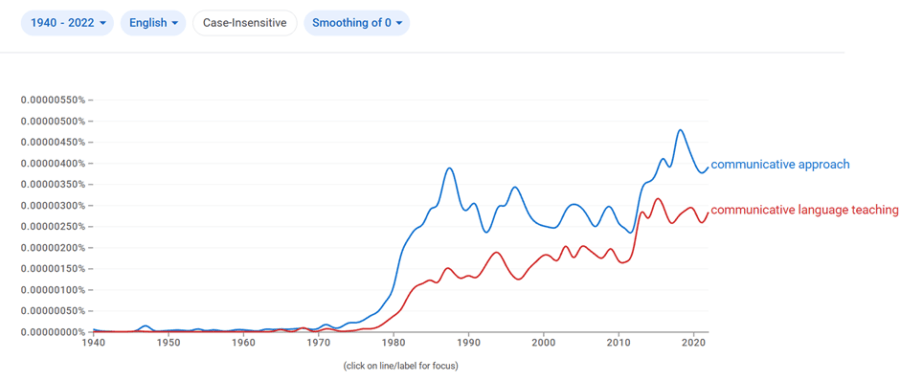
Historical literature on communicative language teaching (CLT) often includes extensive discussion of the origins of “communicative competence” in the work of Dell Hymes, (1966, 1972), as well as its subsequent uptake by others, such as Sandra Sauvignon (1971, 1972) (e.g., Howatt, 1984; Richards & Rodgers, 1986, 2014; Thornbury, 2016). In this sense, the background to CLT’s “big idea” (Howatt with Widdowson, 2004, p. 329) is well documented; although see Anderson (2024) for evidence that subsequent authors didn’t really embrace Hymes’ understanding of “communicative competence”.
However, there are, to my knowledge, no historical publications investigating the origins of the two key terms used to refer to the dominant paradigm in language teaching over the last 50 or so years: “Communicative Language Teaching” and “the Communicative Approach”. Identifying such origins is, arguably, important, because they reveal early understandings of the implications and practicability of this big idea in the classroom, shedding light onto the “significant paradigm shift” (Thornbury, 2016, p. 224) that was about to take place and defining what CLT became (both in theory and practice) and its subsequent longevity. To provide a contrasting example, in the late 1960s, early 1970s there was also plenty of theoretical discussion around what was then called a “cognitive code” approach to language teaching, based directly on some of Chomsky’s ideas (see, e.g., Carroll, 1971; Richards & Rodgers, 1986). I think it’s fair to say that that particular ‘big idea’ never went anywhere!
In this brief blog post I discuss the likely origins of these two phrases, as far as I have been able to establish, identifying two little known (yet important) works as their likely origins. Given that memories and printed texts from the period are likely disappearing, I thought it useful to present this account now; there may be readers who may be able either to confirm the narrative below, or offer any (welcome) corrections for posterity’s sake.
Who coined the phrase ‘communicative language teaching’?
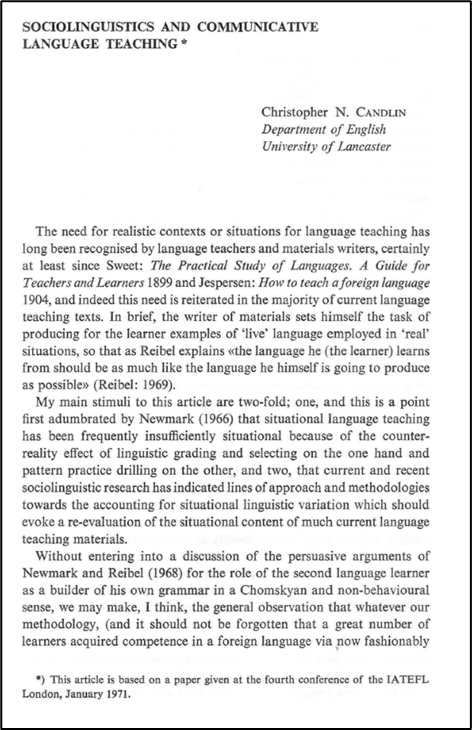
Both my own research (including online sources and document analysis at the University of Warwick’s ELT Archive) and Brumfit’s (slightly erroneous1) research (1986) indicates that Christopher N. Candlin’s 1972 (January) article Sociolinguistics and communicative language teaching was the first publication to use the phrase “communicative language teaching”, a point that is overlooked by Howatt (e.g., 1984; Howatt with Widdowson, 2004), Richards and Rodgers (e.g., 1986, 2014) and more recent historical accounts of CLT. Candlin’s (1972, p. 37) footnote (see Fig. 2) reveals that the article was based on his earlier IATEFL conference plenary, delivered in January 1971, entitled A case for grading (contra Brumfit, 19861).
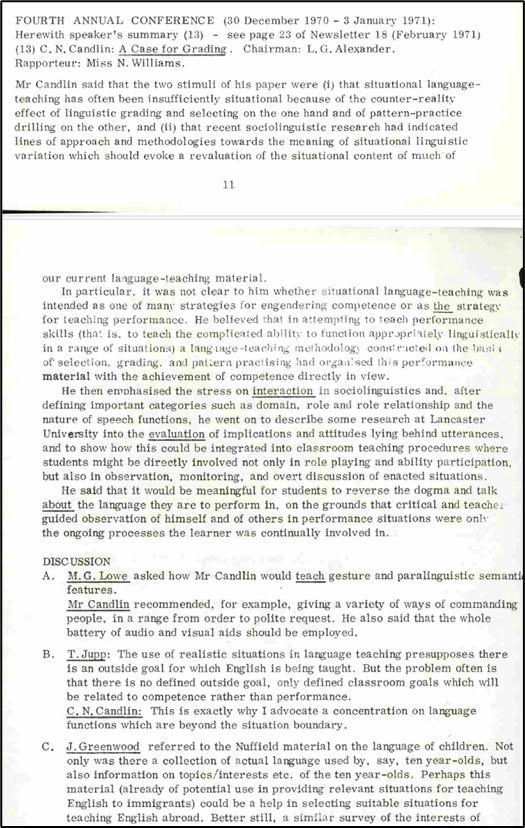
The only remaining (to my knowledge) contemporary account of this talk (Williams, 1971, Fig. 3) notes that Candlin “advocate[d] a concentration on language functions” (p. 12, in ‘Discussion’ in Fig. 3) rather than “situations” (as in the then dominant “situational language teaching” in the UK) for developing competence. It is not clear from this account whether he used the phrase communicative language teaching in the IATEFL talk itself…
Nonetheless, the strong emphasis on teaching language functions is also present in the 1972 paper, where Candlin references both Chomsky and Hymes (including “communicative competence”), and also builds on Reibel’s (1969) seminal discussion of “primary texts” (i.e. text authenticity) as a key means for structuring a syllabus. He stresses the need for “truly communicative language teaching” (a phrase he repeats twice) to draw upon “realistic contexts” and “live language” in “real situations” to enable learners “to communicate effectively in a range of given social situations”. In this sense, Candlin’s paper did indeed constitute an important early vision of communicative teaching that promoted what came to be some of its key defining features, despite the rather uncommunicative title of his IATEFL presentation! Nonetheless, his discussion of the practical implications in the classroom is more limited than Wilga M. Rivers’ slightly later (March, 1972) paper of the same year, although its recommendations are similar:
…the implication of the statements above for language teaching methodology must be that learners become involved in activities like classroom role-playing, dialogue participation, the observation and monitoring of enacted situations, whether actual or filmed. (Candlin, 1972, p. 43)
Candlin’s article, with its repeated stress on the need for the teaching of language functions, has been overlooked in more recent accounts, yet it predates and predicts Wilkins’s Council of Europe (CoE) work (Candlin’s article was published in January, 1972; Wilkins’s syllabus was published in August, 1972), and Widdowson’s seminal paper The teaching of English as communication (published October 1972) that went on to establish some of the theoretical principles that became central to the early development of CLT. Trim’s subsequent (n.d., p. 17) mention of “the early work of Candlin” as an influence on the CoE syllabus indicates awareness of his proposals by the CoE team. The same IATEFL Newsletter (#19, 1971) also includes a list of registered conference participants, who would likely have been at Candlin’s talk, including L. G. Alexander (whose own work underwent a surprisingly communicative turn soon after; see Thornbury, 2016), Dick Allwright, who went on to offer one of the first accounts of the implementation of a communicative course in higher education (Allwright, 1976), “J. Haycraft” (likely John Haycraft of International House), “T. Howatt” (probably the language teaching historian, referenced above, who overlooks this important work of Candlin’s (Howatt, 1984; Howatt with Widdowson, 2004)) and N. S. Prabhu (originator of task-based learning). Despite its importance, Candlin’s paper is not well cited (only 32 citations on Google Scholar).
Which publication first used the collocation ‘communicative approach’?
The earliest text that I have been able to find that uses the collocation “communicative approach” in language teaching contexts is by a key figure in the early development of CLT: David A. Wilkins (1973) and, hence, likely established its use among this discourse community. His paper entitled A communicative approach to syllabus construction in adult language learning (published 4th June 1973, see Fig. 4) was one of his many contributions to the highly seminal Council of Europe team (also including John Trim, René Richterich and Jan van Ek).
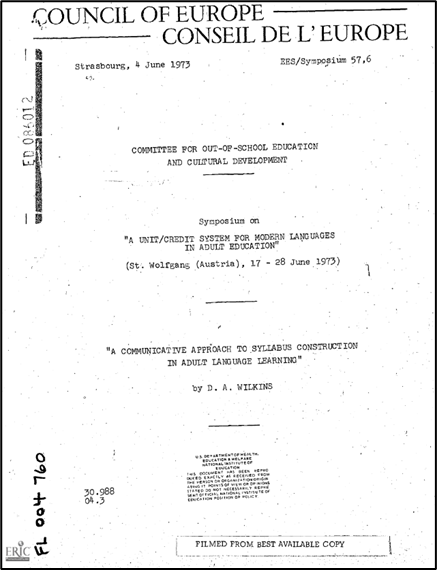
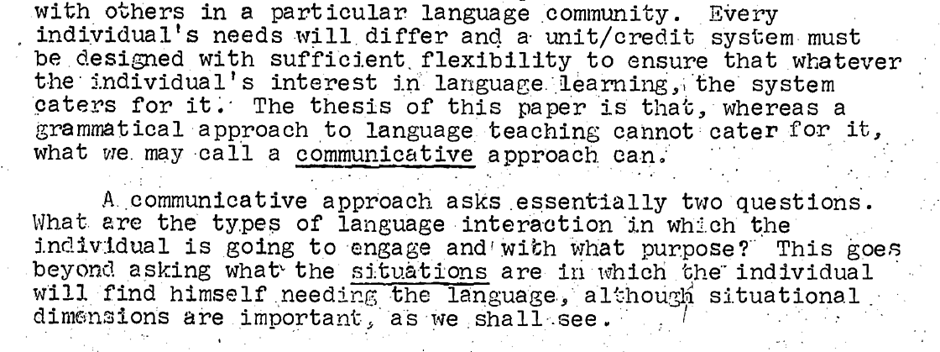
It lays out the foundations for how a communicatively-oriented curriculum is capable of providing for the needs of individual language learners where grammatically-oriented curricula cannot, building on his then recent work on functional-notional syllabi. It is revealing that, when he first mentions the phrase in the body of the article (after emphasising it in the title and abstract), he underlines “communicative” to stress his then innovative contribution (p. 4, see Fig. 5):
The article (also) recognises the importance of “natural language materials [not] specifically written for the learner.” (p. 7) This constitutes important discussion of the later-termed ‘authentic materials’ that were to characterise stronger forms of CLT. Importantly, this paper, along with Wilkins’ other outputs at the time, provided a theoretical basis for course designers to begin developing communicative courses. Like Candlin’s 1972 paper, this particular publication of Wilkins’ is not well cited (only 33 citations on Google Scholar), unlike other works he published at approximately the same time (Wilkins, 1972a, 1972b).
Conclusion
While Wilkins’ contribution to the origins of CLT are well known, many ‘communicative’ teachers may never have heard of Christopher N. Candlin, nor of his influence in our field. Hence, I felt this is an important addition to the history of this approach, although I am aware that this mini research project would benefit from personal testimony/accounts to support the above claims. As mentioned in the introduction above, any confirmation or corrections to this account are welcome, particularly from individuals who may recall Candlin’s IATEFL talk in 1971. Such additions will be incorporated and documented – please add them to the Comments below. Many thanks to the University of Warwick ELT Archive and Prof. Richard Smith, its curator, for access to key documents there.
Notes
1. Brumfit assumed that the IATEFL paper had the same name as the subsequent published article.
References
Allwright, R. (1976). Language learning through communication practice. ELT documents (76/3). English Teaching Information Centre, British Council.
Anderson, J. (2024).Reimagining educational linguistics: A post-competence perspective. Educational Linguistics, 3(2), 258-285. https://doi.org/10.1515/eduling-2023-0009
Brumfit, C. J. (1986). The practice of communicative teaching. Pergamon/British Council.
Candlin, C. N. (1972). Sociolinguistics and communicative language teaching. International Journal of Applied Linguistics, 16(1), 37-44.
Carroll, J. B. (1971). Current issues in psycholinguistics and second language teaching. TESOL Quarterly 5(2), 101-114.
Howatt, A. P. R. (1984). A history of English Language Teaching. Oxford University Press.
Howatt, A. P. R., with Widdowson, H. G. (2004). A history of English language teaching (2nd ed.). Oxford University Press.
Hymes, D. (1972). On communicative competence. In John B. Pride & Janet Holmes (Eds.), Sociolinguistics: Selected readings (pp. 269–293). Penguin. [Note: the original paper was presented at the Research Planning Conference on Language Development Among Disadvantaged Children at Yeshiva University, June 7-8, 1966, and distributed widely afterwards].
Reibel, D. A. (1969). Language learning analysis. International Review of Applied Linguistics, 7(4), 283-293.
Richards, J. C., & Rodgers, T. S. (1986). Approaches and methods in language teaching. Cambridge University Press.
Richards, J. C., & Rodgers, T. S. (2014). Approaches and methods in language teaching (3rd ed.). Cambridge University Press.
Rivers, W. M. (1972). Talking off the tops of their heads. TESOL Quarterly, 6(1), 71-81. https://doi.org/10.2307/3585861
Savignon, S. J. (1971). A study of the effect of training in communicative skills as part of a beginning college French course on student attitude and achievement in linguistic and communicative competence. (Publication No. 7207049) [Doctoral dissertation, University of Illinois at Urbana-Champaign]. ProQuest Dissertations & Theses Global.
Savignon, S. J. (1972). Communicative competence: An experiment in foreign-language teaching. The Centre for Curriculum Development.
Thornbury, S. (2016). Communicative language teaching in theory and practice. In G. Hall (Ed.) The Routledge handbook of English language teaching (pp. 224-237). Routledge.
Trim, J. L. M. (n.d. [1997 or later]) Modern languages in the Council of Europe. Language Policy Division, Council of Europe.
Widdowson, H. G. (1972). The teaching of English as communication. ELT Journal, 27(1), 15-19. https://doi.org/10.1093/elt/XXVII.1.15
Wilkins, D. A. (1972a). Grammatical, situational and notional syllabuses. Council of Europe.
Wilkins, D. A. (1972b). Linguistics in language teaching. MIT Press.
Wilkins, D. A. (1973). A communicative approach to syllabus construction in adult language learning. Council of Europe (paper presented June 17-28, 1973, at symposium: “A unit-credit system for modern languages in adult education”, St. Wolfgang, Austria). Available here: https://files.eric.ed.gov/fulltext/ED086012.pdf
Williams, N. (1971). Fourth annual conference: Speaker summary, C. N. Candlin: A case for grading. IATEFL Newsletter, 19 (May 1971), 11-13.

 Jason Anderson